

There's a comforting story being told in operations circles right now: AI and automation are about to replace the BPO industry. The reality on the ground is quieter and more interesting. The best operations we see — the ones running catalogs, onboarding flows, supplier coordination, and back-office work at scale — are not fully automated. They're deliberately hybrid.
The reason isn't nostalgia for human labor. It's that the work itself doesn't fit neatly into "automate it" or "have a person do it." Every meaningful operational workflow is a mix of mechanical steps and judgment calls, and pretending otherwise is how broken automations are born.
What Automation Does Well
Modern automation — from RPA to LLM-powered agents — is genuinely good at a specific set of tasks. It moves data between systems faster than any human. It applies the same rule a thousand times without fatigue. It surfaces anomalies in large datasets in seconds. For high-volume, low-variance work, it's not just cheaper than people; it's better.
In a well-designed BPO operation, automation owns the mechanical layer: fetching, formatting, syncing, routing, alerting. It handles the parts of the workflow where the answer is always the same given the same input — and it handles them at a scale and consistency a human team can't match.

What Automation Gets Wrong
The trouble starts the moment the workflow needs judgment. And almost every workflow that matters does, somewhere.
Edge cases multiply faster than rules
A rule covers the 80% you anticipated. The remaining 20% is where the value — and the risk — lives. Each new edge case requires a new rule, then a rule for the rule, until the automation is more brittle than the manual process it replaced.
Context lives outside the system
A SKU might pass every automated validation and still be wrong because the supplier emailed the brand a correction yesterday. A customer's onboarding might look complete in the CRM but stall because the champion changed jobs. Software doesn't know what isn't in it.
The cost of confident wrong answers is high
A human flags uncertainty. An automation publishes confidently. When something goes wrong silently in an automated pipeline, you usually find out from a customer — which is the worst possible source.

The Case for Hybrid
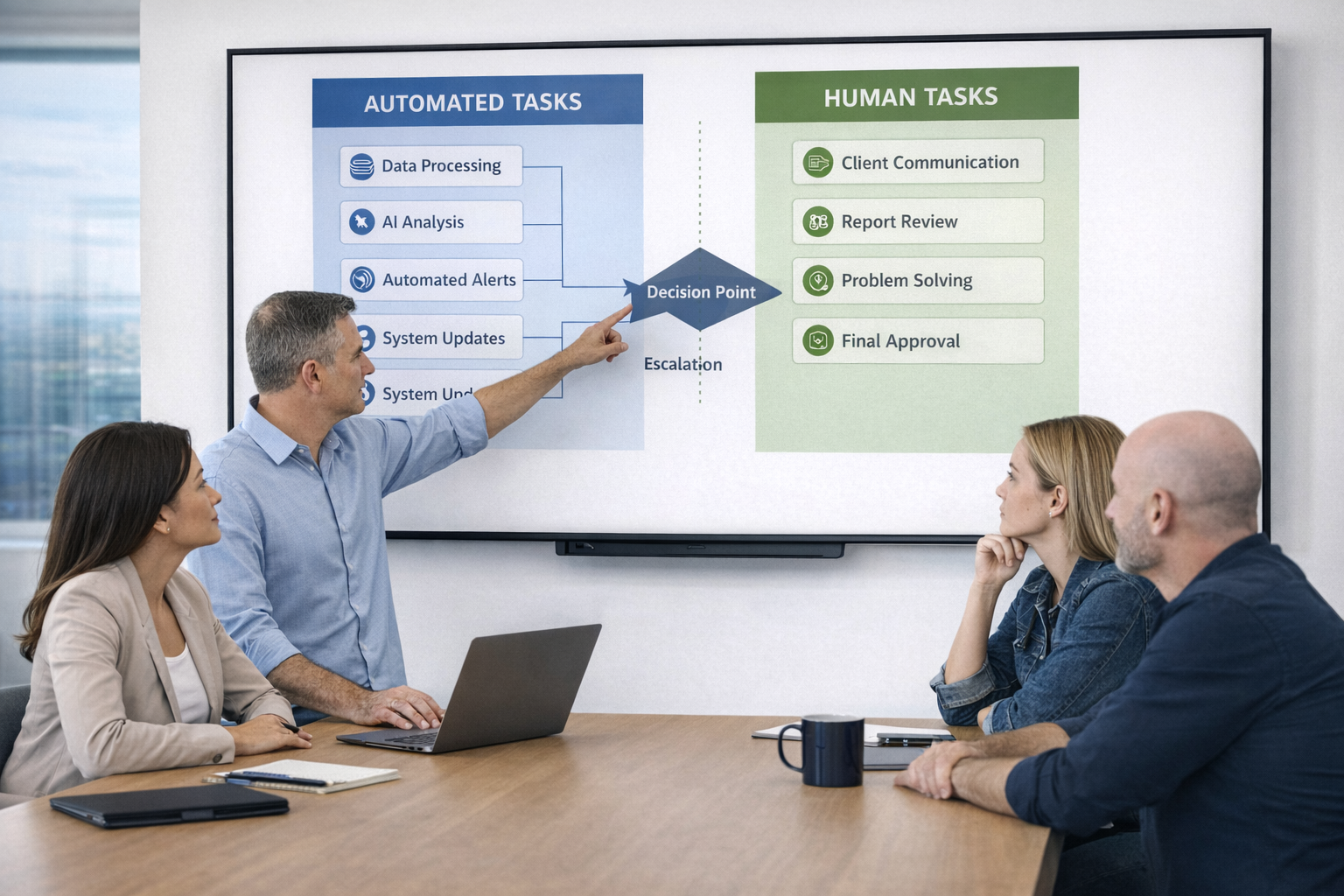
The strongest BPO operations treat humans and automation as collaborators with clearly different jobs — an approach we call Custom Process Orchestration. Automation handles volume and consistency. Humans handle judgment, exceptions, and communication. A well-designed workflow makes the handoff between them obvious.
In practice, that looks like this: an automated pipeline pulls and normalizes data, runs validations, and pushes the clean cases through end-to-end. The exceptions — the items that fail a rule, look anomalous, or need a real decision — are routed to a specialist who reviews them with the full context of the account. The specialist's decisions are logged, and over time the patterns they catch become new rules the automation can handle on its own. The system gets smarter; the humans move further up the value chain.
Designing Your Own Hybrid Operation
If you're building or rebuilding an operational workflow, three questions help draw the line in the right place:
- Where is the answer always the same given the same input? That's an automation candidate.
- Where does a wrong answer cost more than a slow one? That's a human checkpoint.
- Where does the workflow need to communicate with a real person — customer, supplier, internal team? That's a human task, full stop.
Why "Yet" Matters
The honest answer to "will this always need humans?" is: probably not in the same proportions. Every year the line moves. Tasks that needed judgment in 2022 are clean automation candidates in 2025. The operations that win are the ones designed to move that line continuously — not the ones that bet on either extreme.
Fully manual operations don't scale. Fully automated operations don't survive contact with reality. The best BPO operations sit in between, on purpose, and redesign themselves as the tools improve.